A crypto wallet label is human-readable context attached to a public blockchain address or a group of related addresses. It may name a known entity such as an exchange, describe a role such as a hot wallet or deposit wallet, or add another attributed category. The label is not encoded in the address itself, and it does not prove who currently controls the private key.
The term has another meaning too. Wallet software can let a user save private notes for their own addresses, transactions, and outputs. This guide focuses mainly on public attribution labels, while explaining how they differ from those private wallet records.
Address, wallet, entity, cluster, attribution, and label
These terms are often used as if they mean the same thing. They describe different layers of blockchain data.
| Term | Practical meaning |
|---|---|
| Address | A public blockchain identifier used in transactions or account interactions. |
| Wallet | Software, hardware, or a key-management context that can control one or many addresses. |
| Entity | An attributed service, organization, protocol, project, public actor, or other identifiable party. |
| Cluster | A group of addresses linked through evidence or heuristics suggesting common control or operation. |
| Attribution | The process of connecting an address or cluster to a known entity using on-chain and off-chain evidence. |
| Label | Human-readable metadata that presents an entity, role, category, behavior, or other context. |
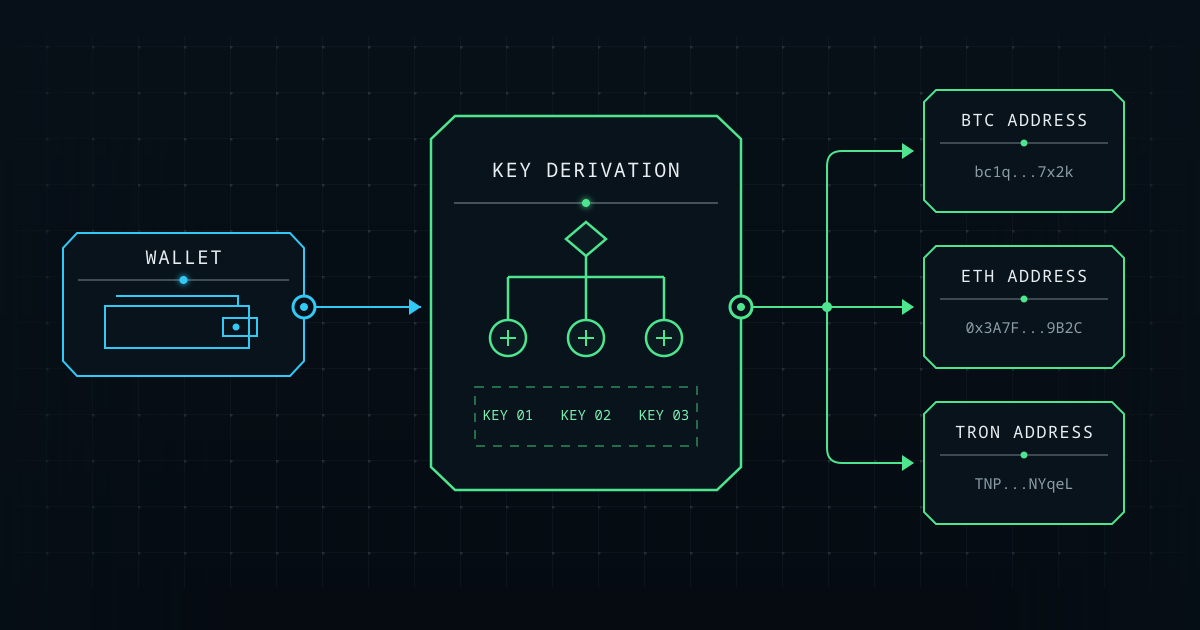
Calling every address a wallet creates false certainty. A Bitcoin wallet can derive and manage many keys and addresses. The Bitcoin developer guide describes wallet programs as software that creates public keys for receiving funds and uses the corresponding private keys for spending. A single visible address is therefore not necessarily the entire wallet.
The terminology also changes by network. Ethereum has externally owned accounts, or EOAs, and contract accounts. An EOA is controlled through private keys, while a contract account is controlled by deployed code. Ethereum’s own documentation also makes the useful distinction that an account is not a wallet: a wallet is an interface used to interact with an account.
For this reason, blockchain address label is usually the more precise technical term. “Wallet label” remains common search and product language, but it should not imply that one address represents every key, account, or address controlled by the same party.
For a beginner-level explanation of those underlying objects, see what a crypto wallet address is and how it differs from a wallet, account, and key.
Public attribution labels and private wallet labels
There are two related but separate uses of labels in crypto.
Private labels in wallet software
A user may add notes such as “salary,” “exchange withdrawal,” or “hardware wallet” to records inside a wallet application. These notes help the user remember why a transaction happened, identify an address, or avoid combining funds that should remain separate.
BIP-329 defines a JSON Lines format for exporting labels attached to Bitcoin wallet records including transactions, addresses, public keys, inputs, outputs, and extended public keys. The specification explicitly treats those exports as privacy-sensitive data and recommends protecting them in transit and at rest.
These labels are personal wallet metadata. They are not automatically published on Bitcoin and should not be treated as a public attribution database.
Public labels and name tags
Explorers and blockchain intelligence products maintain external metadata about public addresses. This data can associate an address with a known organization, identify a contract’s purpose, or place an address in a broader category.
Etherscan, for example, distinguishes between Public Name Tags, Labels, and Public Notes. A name tag can describe an address owner or purpose, while labels group addresses, contracts, tokens, transactions, or blocks into useful categories. That distinction matters: a named entity and an address role answer different questions.
Public attribution is still metadata maintained outside the raw address. A database may be informed by public disclosures, explorer records, manual research, imports, aggregation, or on-chain analysis, but the resulting label does not become an intrinsic property of the blockchain identifier.
What can a crypto wallet label describe?
Useful labeling systems keep several kinds of context separate instead of compressing them into one opaque tag.
A known entity
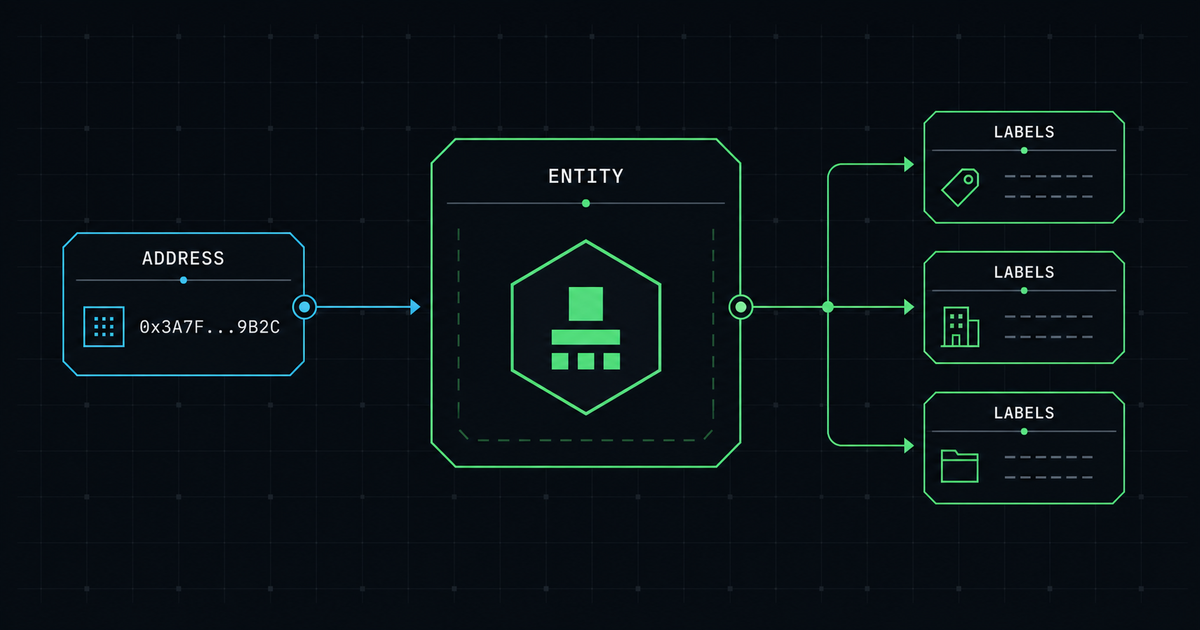
An entity answers the broad question: which known service, organization, protocol, or actor is this address associated with? Examples can include an exchange, bridge, custodian, DAO, DeFi protocol, payment service, mining pool, marketplace, or token issuer.
An entity name should not be confused with a claim about a natural person. An exchange deposit address may be assigned for one customer’s use while the exchange operates the wallet infrastructure and controls the keys. Saying that the address is associated with the exchange is different from proving the identity of its beneficiary.
An operational role
A role explains what an address appears to do within an entity’s infrastructure. Examples include:
- exchange hot wallet;
- exchange cold wallet;
- deposit or withdrawal wallet;
- treasury wallet;
- bridge address;
- validator;
- deployer or proxy contract.
The entity and the role should remain separate fields. “Kraken” and “Exchange Cold Wallet,” for example, carry different information: one names an attributed entity and the other describes the address’s operational role.
A category or contextual signal
Labels can also group context into categories such as centralized exchange, custody, DeFi, treasury, infrastructure, behavior, flow, or sanctions. Some systems include behavioral or compliance-related observations alongside identity labels.
Those observations require especially careful wording. A category is not automatically a verdict, and a descriptive label should not be silently converted into a numeric risk score or a legal conclusion.
Where do blockchain address labels come from?
No single method produces every reliable label. The source of the information and the method used to process it are separate questions.
Public disclosures and verifiable records
Projects, exchanges, protocols, public figures, and government bodies sometimes publish addresses directly. Explorer name tags may also link to supporting pages or verified contract information. Direct public evidence can be strong, but it still needs to be checked for chain, address, context, and date.
Aggregation and imports
A service may normalize records from several public datasets into one schema. Aggregation is useful because sources use inconsistent names and categories, but normalization can also hide meaningful differences unless the API preserves source, method, and status metadata.
Manual review
Researchers and moderators can resolve naming conflicts, review supporting evidence, and reject implausible attributions. Manual review improves consistency but does not make a conclusion permanent. Organizations rotate infrastructure, contract ownership changes, and old roles can become historical.
On-chain analysis and heuristics
Transaction structure and operational patterns can suggest relationships between addresses. In Bitcoin’s UTXO model, analysts may use transaction heuristics to identify groups of addresses that appear to share control. Account-based networks such as Ethereum do not expose the same multi-input structure, so they require different evidence.
Heuristics have known failure modes. They should produce documented, reviewable claims rather than be presented as certain identity facts.
Clustering, attribution, and labeling are different
Address clustering, attribution, and labeling form a pipeline, but they are not interchangeable.
- Clustering makes a structural claim that multiple addresses are related or may share control.
- Attribution connects an address or cluster to a named entity using additional evidence.
- Labeling presents that result as readable metadata for an analyst, explorer, application, or API consumer.
Research on cryptocurrency address clustering and labeling describes how behavioral patterns may group addresses before known attribution is assigned. A current address clustering overview similarly separates structural grouping based on blockchain evidence from the off-chain work required to name an entity.
This separation limits error propagation. If a weak clustering assumption incorrectly adds one address to a group, an entity label applied to the entire cluster can spread the mistake. A smaller, well-supported result is more useful than a broad attribution that hides its uncertainty.
How CryptoLabel represents an address label
CryptoLabel returns the address, presentation entity, and labels as separate objects. It also keeps machine-readable enum values next to readable text, allowing applications to render a friendly result without discarding the underlying data contract.
The following shortened example uses the current public response model:
{
  "query": {
    "chain": "ethereum",
    "address": "0x22af984f13DFB5C80145E3F9eE1050Ae5a5FB651"
  },
  "address": {
    "type": "eoa",
    "readableType": "Externally Owned Account",
    "model": "account_based",
    "readableModel": "Account-based model"
  },
  "entity": {
    "name": "Kraken",
    "category": "exchange",
    "readableCategory": "Exchange"
  },
  "labels": [
    {
      "type": "exchange_cold_wallet",
      "readableType": "Exchange Cold Wallet",
      "category": "cex",
      "readableCategory": "Centralized Exchange",
      "sourceType": "public",
      "readableSourceType": "Public",
      "method": "aggregation",
      "readableMethod": "Aggregation",
      "status": "active",
      "readableStatus": "Active"
    }
  ]
}
Each layer answers a different question:
-
address.typeandaddress.modeldescribe the blockchain object and accounting model; -
entitysupplies the normalized presentation name and entity category; -
labels[].typedescribes a more specific role or observation; -
sourceTypedescribes where the label came from; -
methoddescribes how it was obtained or processed; -
statusdistinguishes active, inactive, and historical context.
An address can have zero, one, or multiple labels. An empty label array is meaningful: it says that no label is available in the current dataset, not that the address is safe, unsafe, inactive, or controlled by an unknown individual.
The complete field definitions and allowed values are available in the API documentation.
What a wallet label cannot prove
A label adds context, but it is not cryptographic proof of identity or control.
A public address label does not automatically provide:
- the legal identity of an arbitrary person;
- proof that the named entity still controls the address;
- wallet balances or token holdings;
- transaction history or graph analysis;
- sanctions screening or a complete AML/KYT decision;
- a numeric risk score;
- guaranteed scam detection.
Control and identity are also different claims. A valid cryptographic signature can demonstrate control of a key at a particular moment, but it does not necessarily establish the signer’s legal identity. Conversely, public evidence can associate infrastructure with an organization without exposing every individual who can authorize transactions.
Labels can be incomplete, stale, disputed, or wrong. Their reliability depends on the evidence, the transformation applied to that evidence, the age of the record, and whether the address role can change.
How should you evaluate a wallet label?
Use labels as inspectable context rather than as a final verdict.
- Verify the chain and exact address. Similar-looking strings and cross-chain formats can refer to different objects.
- Separate entity from role. An entity association does not automatically explain whether an address is a deposit wallet, treasury, contract, or historical endpoint.
- Inspect source and method. A public disclosure, manual review, aggregation, import, and heuristic do not carry identical evidence.
- Check status and freshness. Active, inactive, and historical labels should not be presented as equivalent.
- Look for more than one label. Multiple compatible labels may describe different layers rather than conflict.
- Corroborate important conclusions. For compliance, legal, or high-impact decisions, review independent evidence and use the appropriate specialist process.
Applications should also handle an unknown result explicitly. Replacing missing attribution with a confident identity or risk assumption makes the interface look complete while reducing its accuracy.
You can look up a supported public address through the website or integrate the same normalized context through the blockchain address labeling API.
Frequently asked questions
Are crypto wallet labels public?
It depends on the label. Public attribution databases and explorer name tags are intended to provide shared context. Notes created inside wallet software may be private and can reveal sensitive information about transactions, addresses, or ownership structure.
Are wallet labels stored on the blockchain?
Public address labels are usually metadata maintained by an explorer, analytics provider, application, or researcher rather than a field embedded in the address. Some naming and registry systems may use on-chain records, but that does not make every wallet label an on-chain fact.
Can a wallet label identify a person?
Sometimes an address can be associated with a person who publicly declared or cryptographically demonstrated control. Most arbitrary addresses do not reveal a natural person’s legal identity by themselves. A service or entity attribution should not be rewritten as personal identification.
Can one address have multiple labels?
Yes. One label may name an operational role, another may describe a category, and another may preserve historical context. A good schema returns these records separately instead of forcing every observation into one string.
Can wallet labels be wrong?
Yes. Sources can be inaccurate, infrastructure can change, and clustering or normalization can introduce errors. Source, method, status, and supporting evidence help a consumer judge how a label should be used.
Is a wallet label the same as an Etherscan name tag?
They are related, but not identical. Etherscan describes a public name tag as an owner or purpose attached to an address, while its labels organize pages into broader categories. Other products may use different taxonomies, which is why normalized entity and label fields are useful for integrations.