A crypto wallet address is a public
identifier used to receive assets or interact with an account
on a blockchain. It is usually displayed as a long string of
letters and numbers, such as a Bitcoin address beginning with
bc1, an Ethereum address beginning with
0x, or a Tron address beginning with
T.
The address tells a blockchain where a transaction is intended to go. It is not the wallet application, it is not a private key, and it does not necessarily identify a person. Those distinctions matter because one wallet can manage many addresses, and an address can represent something other than an individual user, including an exchange deposit endpoint or a smart contract.
Wallet, address, account, and key are different things
Wallet interfaces often hide the underlying cryptography, which makes several separate concepts look like one object.
| Term | Practical meaning | Should you share it? |
|---|---|---|
| Wallet | Software, hardware, or a key-management system used to view accounts and authorize actions. | The product name is not secret, but access credentials are. |
| Address | A public, network-specific destination or identifier used in blockchain activity. | Usually yes, when you need to receive assets or identify an account. |
| Account | An entry in an account-based blockchain state, such as an Ethereum EOA or contract account. | Its address is public; its means of control may be private. |
| Public key | Cryptographic data derived from a private key and used to verify signatures. | It is not a spending secret, though an application may not need it. |
| Private key | Secret data used to sign transactions or messages for a key-controlled account. | Never. Anyone who obtains it may be able to control the associated assets. |
| Recovery phrase | Words used by many wallets to derive or restore a hierarchy of keys. | Never. It may restore every account derived from that wallet seed. |
A wallet therefore does not literally contain coins in the way a physical wallet contains cash. The blockchain records the relevant state or spendable outputs. The wallet manages the information needed to find those records and, when authorized, create valid signatures.
Ethereum makes the terminology especially clear: an account is not a wallet. A wallet is an interface for interacting with an externally owned account or, in some workflows, a contract account. On Bitcoin, the developer guide describes wallet programs as systems that generate or distribute receiving information, monitor the blockchain, and sign transactions with the appropriate private keys.
How is a crypto wallet address created?
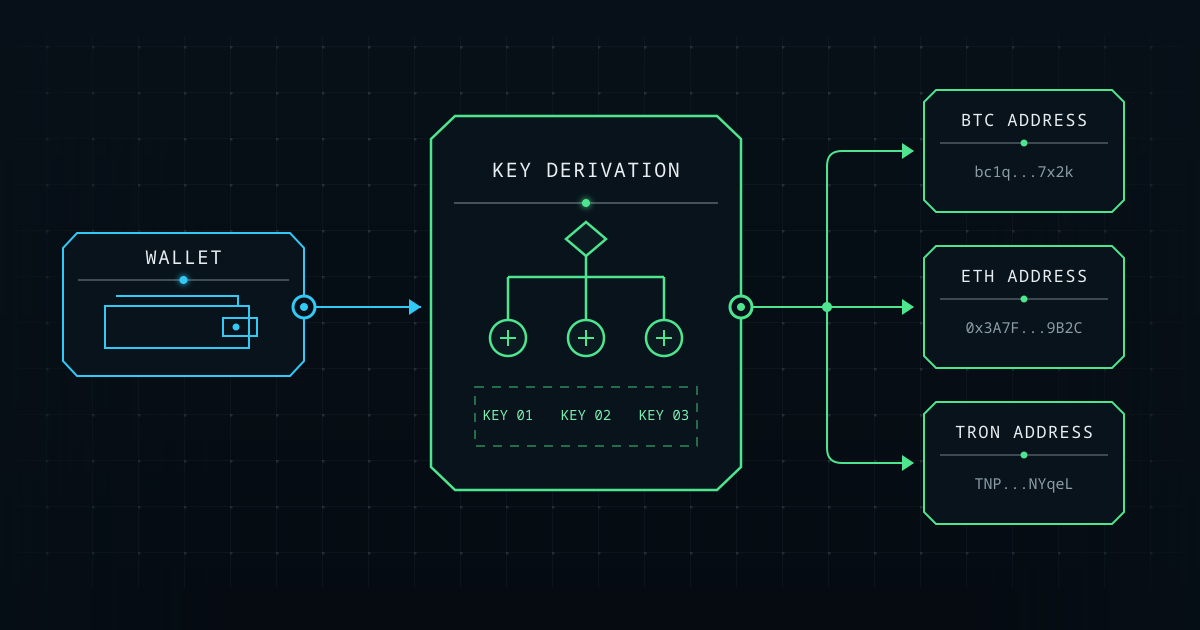
For a typical key-controlled account, wallet software starts with secret key material, derives a public key, and applies the blockchain’s addressing rules. A simplified flow looks like this:
recovery phrase or wallet seed
             ↓
        private keys
             ↓
         public keys
             ↓
  network-specific addresses
This is a useful model, but it is not a universal formula for every blockchain address.
- A Bitcoin address commonly encodes information about a locking script or a hash used by that script. Different script types produce different address formats.
- An Ethereum externally owned account, or EOA, is based on a key pair. Its address is formed from the final 20 bytes of the Keccak-256 hash of the public key.
- An Ethereum contract account has no private key. Its address is created when the contract is deployed and its behavior is controlled by code.
- A Tron EOA uses the same secp256k1 key-pair foundation as Ethereum, then applies Tron’s network prefix and address encoding. Tron contract addresses are also controlled by code rather than a private key assigned to the contract.
The important rule is that knowing a public address does not let someone calculate its private key or authorize a transaction. The signing secret remains inside the wallet or key-management system unless it is exposed through theft, phishing, an unsafe backup, or another security failure.
Why can one wallet have multiple addresses?
“My wallet address” sounds singular, but many wallets manage a collection of keys, addresses, or accounts.
Bitcoin wallets commonly derive a sequence of addresses from one wallet seed. They can issue a fresh receiving address for a payment and create a separate change address when a transaction does not spend an input value exactly. The Bitcoin wallet documentation explains how hierarchical deterministic wallets derive many child keys from shared root material.
Account-based wallets may also expose multiple accounts. A
browser wallet can let a user switch between several Ethereum
EOAs, each with its own address and transaction nonce. One EOA
address may look identical across EVM-compatible networks, but
the state on each network is separate. Seeing the same
0x... string on Ethereum and another EVM chain
does not make those networks interchangeable.
Custodial services add another layer. An exchange may assign a deposit address to a customer while the exchange controls the wallet infrastructure and private keys. The address can be associated with the exchange even though the customer does not possess the key.
Common wallet address formats
An address format can help identify how a string should be parsed. It cannot by itself prove who controls the destination or whether sending to it is appropriate.
| Network | Common visible formats | What the format tells you |
|---|---|---|
| Bitcoin |
1..., 3...,
bc1q..., bc1p...
|
The network and the type of locking or witness program represented by the address. |
| Ethereum |
0x followed by 40 hexadecimal characters
|
A 20-byte account address; the same shape is used for EOAs and contracts. |
| Tron | Base58Check address beginning with T |
A user-facing Tron account representation; EOAs and contracts share the format. |
Bitcoin addresses
Bitcoin has several address families because its transaction capabilities have evolved:
-
1...commonly represents a legacy Pay-to-Public-Key-Hash, or P2PKH, destination; -
3...commonly represents Pay-to-Script-Hash, or P2SH, which can describe several script arrangements and is not exclusively a SegWit marker; -
bc1q...represents a native SegWit version 0 program using the Bech32 encoding defined by BIP-173; -
bc1p...represents a SegWit version 1 Taproot program using the Bech32m encoding defined by BIP-350.
Bitcoin is a UTXO-based network. An address is a convenient representation of spending conditions, not an account object with a persistent protocol-level balance field.
Ethereum addresses
An Ethereum address contains 0x followed by 40
hexadecimal characters. Mixed capitalization may encode a
checksum under
EIP-55,
but all-lowercase and all-uppercase representations are also
used by software.
The visible format alone does not tell you whether the destination is an EOA or a smart contract. Both have 20-byte addresses, and determining the type requires checking the Ethereum state. It also does not identify the correct EVM network: the same address syntax is used on multiple chains.
Tron addresses
Tron commonly displays addresses as 34-character Base58Check
strings beginning with T. The protocol can also
represent an address in hexadecimal form with a
41 network prefix. The
official Tron account documentation
describes both forms and confirms that externally owned and
contract accounts use the same visible address format.
A TRC-20 token uses a Tron account address; “TRC-20 address” is not a separate address type. The sender still needs to choose the Tron network and the correct token contract.
What can a public wallet address reveal?
Public blockchains are designed to make their ledger state verifiable. Depending on the network and available tools, an address can be used to inspect:
- confirmed transactions or transfers involving the address;
- native-asset or token balances represented by the public ledger;
- interactions with smart contracts;
- whether an account contains contract code;
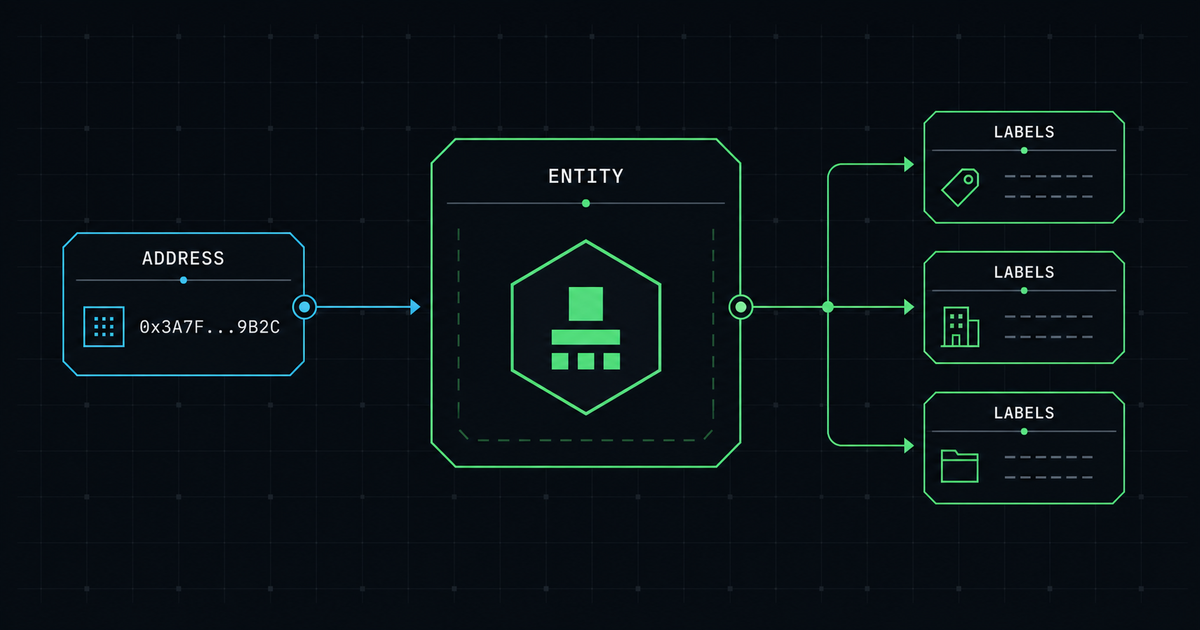
- public name tags, known-entity attribution, or operational labels maintained by external data providers.
That visibility makes most public addresses pseudonymous, not automatically anonymous. The blockchain supplies the activity record, while off-chain evidence may connect an address to an exchange, project, protocol, organization, or public actor.
An attribution label still is not cryptographic proof of a natural person’s identity. It may describe infrastructure controlled by a service, a historical role, or an association supported by public evidence. For a deeper explanation, see what crypto wallet labels mean.
CryptoLabel focuses on address type, known entity context, and labels. It does not provide balances, transaction history, a risk score, or proof that a named party currently controls an address.
Is it safe to share a wallet address?
A public address is intended to be shared when someone needs to send assets to it. Sharing the address alone does not grant signing authority and should not expose the private key.
There are still privacy and operational risks:
- another person may inspect activity associated with the address;
- repeatedly publishing the same address can make separate payments easier to connect;
- a public profile, invoice, exchange record, or other off-chain evidence can link an address to an identity;
- an attacker can use visible holdings or activity to create more convincing phishing messages;
- a copied address can be replaced by clipboard malware or confused with a lookalike address.
Never share a private key, recovery phrase, wallet backup, one-time authentication code, or a screen that exposes those secrets. A legitimate sender only needs the public destination and the correct network.
How to check an address before sending crypto
Blockchain transfers are often difficult or impossible to reverse, so syntax validation is only the first check.
- Confirm the network and asset. An Ethereum-shaped address can appear on several EVM networks, and stablecoins with the same ticker can exist on unrelated chains.
- Obtain the address from a trusted channel. If the destination is an exchange, merchant, or protocol, use its current official deposit or payment flow.
- Compare the complete address. Do not rely only on the first and last few characters. Attackers can generate lookalike strings; large-scale research on blockchain address poisoning documents this attack pattern.
- Use the wallet’s validation and warning features. A checksum can catch some accidental edits, but it cannot confirm the intended recipient.
- Send a small test amount when the stakes justify it. Verify that it arrives on the expected network before transferring the remainder.
- Inspect public context when available. An entity or contract label can help confirm a known destination, but an unknown result is not evidence that an address is safe or unsafe.
Common wallet address misconceptions
“The wallet and the address are the same”
A wallet manages keys and interactions. An address is one public identifier the wallet may use. One wallet can manage many addresses or accounts.
“Every address belongs to a person”
An address may represent a contract, exchange infrastructure, a multisignature policy, a project treasury, or another operational endpoint. Even a key-controlled address does not publish the legal identity of the key holder.
“The same-looking address means the same network”
Address syntax can overlap. Ethereum and other EVM-compatible
networks use the same 0x... shape, while the
balances and transaction histories exist in separate ledgers.
Network selection is part of the destination.
“A recognized format means the address is safe”
Format validation can reject malformed input. It cannot detect every scam, compromised account, incorrect token contract, or address substituted by an attacker.
Frequently asked questions
What is the difference between a wallet and a wallet address?
A wallet is software, hardware, or a broader key-management system used to interact with blockchain assets. A wallet address is a public identifier used as a transaction destination or account reference.
Is a wallet address the same as a public key?
Usually not. Key-controlled addresses are commonly derived from public keys, but the transformation depends on the blockchain. Contract addresses can be created from deployment data rather than from a public key belonging to the contract.
Can someone steal crypto with only a wallet address?
Knowing an address does not provide the private key or signing authority. However, publishing an address can expose financial activity and give an attacker information for phishing or social engineering.
Does a crypto wallet address expire?
Protocol addresses generally do not have an expiration date, but a service can retire a deposit route, change supported networks, or ask customers to generate a new address. Recheck old payment instructions before sending.
Can the same address receive different tokens?
On account-based networks, one address can often receive the native asset and compatible tokens. The token and network must still be supported by the receiving wallet or service. An identical token ticker does not guarantee cross-network compatibility.
Can a wallet address reveal its owner?
An address alone normally does not reveal the legal identity of an arbitrary person. Public disclosures, service records, verified signatures, and attribution research can sometimes associate an address with a known entity or public actor, but that association should not be presented as universal ownership proof.